


At one of the access networks, we noticed something odd.
Traffic drops. Every day, right around the same time.
Same pattern. Same timing. No alerts.

The drop wasn’t random. Instead, it showed up consistently in the time-series:
Same time
Similar magnitude
Clean recovery afterward
There were no spikes or instability leading up to the drop, just a steady and predictable dip. At first glance, this usually points to congestion, capacity limits or routing issues.
But this didn’t behave like any of those.
That’s where things changed
We started peeling it back. From overall traffic → to contributing networks → down to individual flows.

Using BENOCS’ Raw Network Analyzer, we then looked at the actual subnets.
Specific IPs stood out, and a reverse lookup pointed to something more specific: an embedded cache inside the network in question.
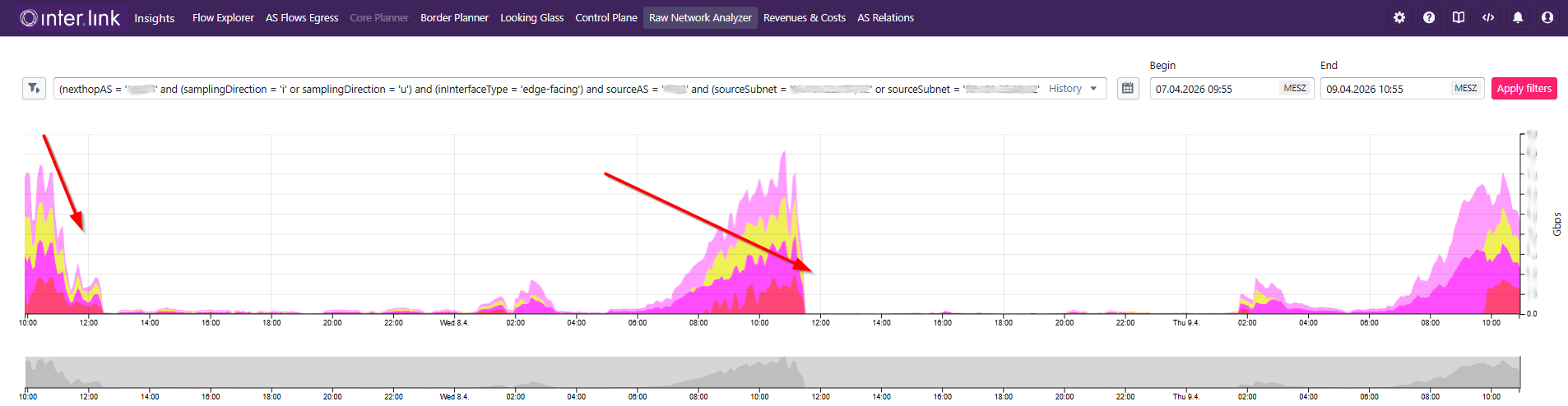
Now the pattern starts to shift from “network issue” to something else entirely.
So what’s actually happening here?
A few possibilities emerge:
A scheduled cache refresh or content rotation
Demand shifting at a very specific time of day
Traffic being redirected based on cost or policy
Application-driven behavior rather than network-driven
Questions worth thinking about
Why would traffic drop so precisely at the same time every day?
What kind of content creates such a synchronized pattern?
Is this driven by users or by infrastructure?
And more importantly, is this even a “problem”?
Important to remember
Not every anomaly is an incident. Some are patterns. And patterns are often more valuable than incidents in showing how the network actually behaves.
The real value isn’t in spotting the drop.
It’s in understanding why it’s there in the first place.