


Three assumptions worth checking
One month of internet infrastructure news, read the way an operator should read it: not as three separate stories, but as three quiet shifts in how resilience, sovereignty and capacity actually work.
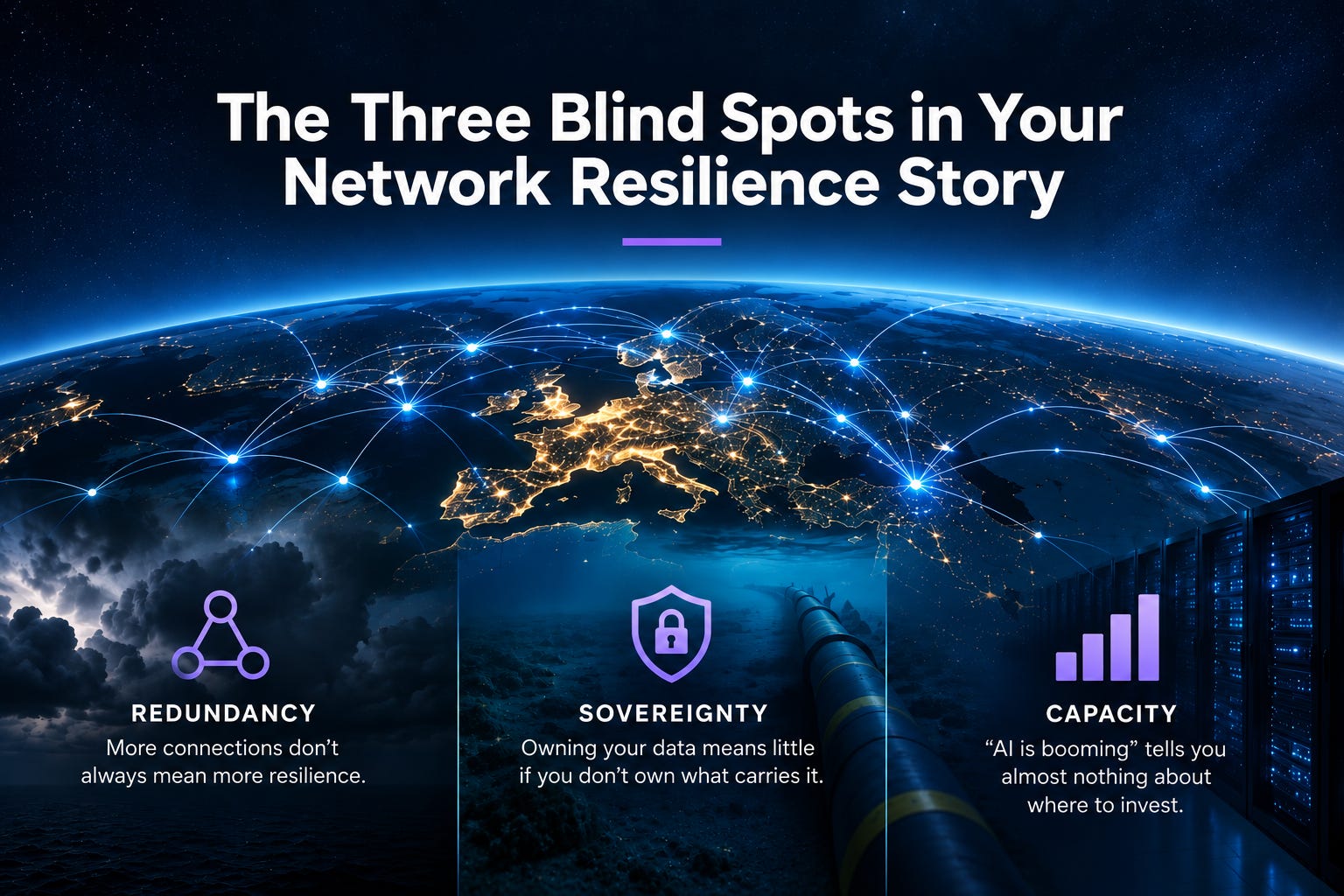
1. The redundancy blind spot. Why a “highly connected” network can still fail in ways geography never predicts.
2. The sovereignty blind spot. Why owning your data means little if you don’t own, or influence, what carries it.
3. The capacity blind spot. Why “AI is booming” tells you almost nothing about where to spend your next euro.
Plus: three questions to ask this week. A short, practical checklist to run against your own network before your next planning cycle.
AUGUST 2026, IN NUMBERS
20 minutes became a fault reaching 30 countries
On 14 August, a roughly 20-minute outage centred on Chicago, Boston and New York still reached customers in the US, Canada, Mexico, Singapore and Thailand. A week later, a second, intermittent incident ran for about three hours and touched connectivity in around 30 countries.
Neither event made mainstream headlines. Both point to the same, easy-to-miss pattern behind three of August’s quieter infrastructure stories – and to three assumptions worth checking in your own network. Source: Arelion incident reports, 14 and 21 August 2026, as referenced in “Resilience, Sovereignty and the Reality Behind AI Traffic”, Hari Jayaraman, BENOCS.
BLIND SPOT 1 OF 3
“Highly connected” is not the same as “resilient”
On 14 August, Arelion had a roughly 20-minute outage centred on three US cities that still reached customers as far away as Singapore and Thailand. A second incident a week later ran intermittently for about three hours and touched roughly 30 countries. Geography told you almost nothing about where the impact would land.
Reframe: Internet reachability isn’t a geography problem, it’s a BGP and path-dependency problem. A fault becomes global the moment enough downstream networks depend on the affected route, wherever that route physically sits.
Check this: Can you name, today, which of your critical paths depend on a single upstream network or route, including ones you rarely think about? If not, redundancy on paper may not be redundancy in practice.
BLIND SPOT 2 OF 3
Owning your data isn’t the same as owning what carries it
Meta is building a new submarine cable of roughly 7,000 km between New York and Denmark, targeting January 2028. Its Danish landing station belongs to Arelion, and the cable is expected to be open. But it sits inside a bigger pattern: over the past five to six years, hyperscalers have taken an increasingly leading role in submarine cable investment, while traditional operators have stepped back.
Reframe: Sovereignty debates usually ask where data is stored. They rarely ask who owns the physical infrastructure that carries it, even though that question increasingly decides who sets the terms of connectivity.
Check this: Of your critical international routes, how many run over infrastructure your organisation neither owns nor has direct commercial leverage over?
BLIND SPOT 3 OF 3
“AI is booming” doesn’t tell you where to invest
Dell’Oro projects 40% compound growth in AI-driven demand for front-end networks, and Cisco reports record hyperscaler orders. At the same time, Light Reading points to a capacity glut elsewhere in telecom: Verizon and T-Mobile are holding capital spending broadly flat, and AT&T’s increased spending is reportedly driven mainly by fibre broadband, not AI.
Reframe: Both things are true at once. Enormous AI-driven demand can sit at the hyperscaler and core level while the access layer carries excess capacity. The real question isn’t how much AI traffic exists, it’s who is driving it, where in the network it lands, and who ultimately pays.
Check this: Is your current capacity plan built around where AI traffic is actually landing on your network, or around the headline growth number?
PUTTING IT TOGETHER
Three questions worth asking before your next planning cycle
Resilience is becoming less about physical geography and more about understanding interconnected paths. Sovereignty is increasingly about infrastructure ownership, not just data. And the AI boom may be creating very different economic pressures across different layers of the network. None of this shows up in a standard capacity report – but all of it shows up in network path data, if you know where to look.
REDUNDANCY
SOVEREIGNTY
CAPACITY
Map your top five critical paths by dependency, not by contract. Which single networks or routes, if disrupted, would take out connectivity you assumed was diverse?
List your international routes by infrastructure ownership, not by traffic volume. Where does your actual leverage sit, and where doesn’t it?
Separate your AI-driven demand forecasts from your access-layer utilisation. Are you planning for the same traffic twice, or missing where it will really show up?
BEFORE YOUR NEXT CAPACITY CALL
Want this kind of reading before it happens, not after?
Don’t have time to track every BGP advisory, cable filing and capacity report yourself? The Connectivity Insight Initiative does it for you.
Independent analysis of outages, ownership shifts and traffic trends as they happen, not just the headlines.
Written for network operators, peering and interconnection teams – not press releases. Free to subscribe. A joint effort from BENOCS and Inter.link, with no sales pitch attached.
Download a PDF of this full report:
